Coin value comes from four things you can mostly check yourself: the date and mint mark, the grade, the metal, and how many collectors want that coin. Most coins from jars, drawers and inherited boxes are common and trade close to face value or close to their metal value. A smaller group carries a real premium. This page shows how to sort yours, then points you to the detailed checkers for silver dollars and pennies.
What decides coin value
- Date and mint mark together. The same design can be common one year and scarce the next, depending on how many were struck at each mint and how many survived.
- Grade. Condition is graded on a 1 to 70 scale. A coin with no wear can be worth many times a worn coin of the same date.
- Metal. Older US silver and all gold coins have a floor set by the metal inside, however worn they are.
- Demand. Morgan dollars, Lincoln cents and Mercury dimes have deep collector demand. An old foreign coin can be scarce and still sell for little if few people collect it.
Age alone does not make a coin valuable. Plenty of coins over 100 years old sell for a few dollars.
How to read the date and mint mark
US mint marks are small letters: P for Philadelphia (often no letter on older coins), D for Denver, S for San Francisco, O for New Orleans, CC for Carson City and W for West Point. Where to look:
- Lincoln cents: under the date on the front.
- Morgan dollars: on the back, below the wreath.
- Mercury dimes: on the back, to the left of the bundle of rods (fasces) near the bottom.
- Washington quarters: on the back below the eagle on coins dated 1964 and earlier, and on the front, behind the hair ribbon or beside the neck, on coins from 1968 on (1965-1967 quarters have no mint mark).
A 5x to 10x loupe and light from the side make small marks readable. Added mint marks and altered dates are a known trick on key dates, so check that the mark matches the metal around it.
Silver dollars
Morgan dollars (1878-1904, 1921) and Peace dollars (1921-1935) are 90% silver with 0.7734 troy ounces of pure silver. Common dates trade a bit above melt, while key dates such as the 1893-S Morgan and 1928 Peace sell for hundreds to thousands of dollars. Eisenhower, Susan B. Anthony and Sacagawea dollars from circulation contain no silver. Our silver dollar value checker covers mint marks, key dates and counterfeits in detail.
Pennies
Most cents are worth one cent, even after the Mint ended circulating penny production in November 2025. The exceptions are key-date wheat cents (1909-S VDB, 1914-D, 1922 no D, 1931-S), the rare 1943 copper cent, the 1955 and 1972 doubled dies, and top-condition coins. See the penny value checker for the magnet test, the 1982 weight test and price figures.
Take a picture and check its value with the estimator at the top of this page.
Pre-1965 silver dimes, quarters and half dollars
US dimes, quarters and half dollars dated 1964 and earlier are 90% silver. Kennedy half dollars from 1965 to 1970 are 40% silver, and Jefferson nickels from 1942 to 1945 with a large mint mark above Monticello contain 35% silver.
For common dates in worn condition, value follows the silver price. The formula is silver weight in troy ounces times today's spot price. The silver weights are 0.0723 oz for a dime, 0.1808 oz for a quarter, 0.3617 oz for a 90% half dollar and 0.1479 oz for a 40% Kennedy half (NGC Coin Explorer, November 2026). Look up a live spot quote when you do the math.
A quick test: 90% silver coins show a solid silver edge, while clad coins from 1965 on show a copper stripe.
Key dates break away from melt. The 1916-D Mercury dime, with a mintage of 264,000, lists at about $1,700 in Good, and the 1932-D Washington quarter at about $85 in Good (NGC Price Guide, November 2026). The 1932-S quarter is the other key in that series.
Gold coins
US gold coins struck before 1934 are 90% gold. A $20 double eagle holds 0.9675 troy ounces of gold and a $10 eagle holds 0.484 ounces (NGC Coin Explorer, November 2026). Melt works the same way: gold weight times today's gold spot price. Common dates sell for a modest premium over that, while rare dates and high grades are worth far more. Gold is a favorite of counterfeiters, so buy and sell through established dealers, and have any rare date authenticated. Modern bullion coins such as the American Gold Eagle are priced mostly on their gold weight.
Foreign coins
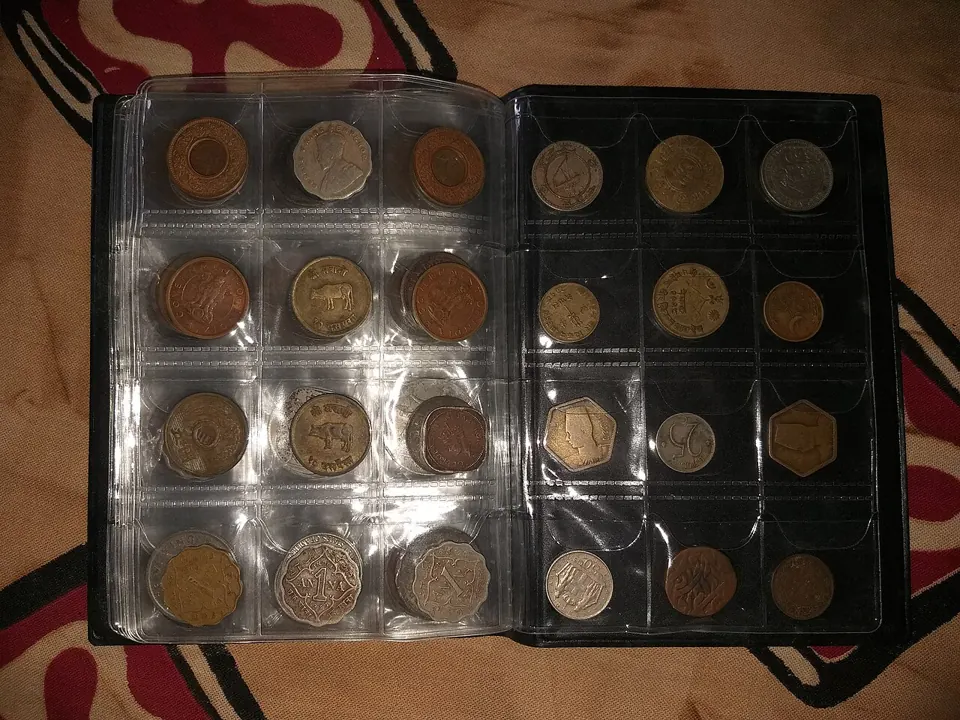
Most foreign coins brought home from travel or military service are common and worth little more than their metal. The ones to look at more closely are silver crowns, gold coins of any country, and older coins in sharp condition. Demand is the main limit here, since many foreign series have few US collectors.
Error coins
Real mint errors exist: doubled dies, off-center strikes, coins struck on the wrong blank, clipped blanks. Most "rare error" claims online are post-mint damage, worn dies or machine doubling. A real off-center strike shows a blank crescent with the design cut off cleanly. A coin that is bent, squeezed, plated or has a smeared surface was usually damaged after it left the mint. Compare any claim against sold listings for the same error.
Price guidance
The figures above come from published dealer price guides and are a starting point, not an offer. As a general pattern on the market: modern clad coins sell at face value; common wheat cents sell for a few cents; common 90% silver coins sell near melt; common Morgan and Peace dollars sell for melt plus a premium; recognized key dates and errors in genuine condition sell for hundreds of dollars or more. Dealer buy prices are lower than retail guides, so check sold listings for the same date, mint mark and grade before you price anything.
Cleaning
Do not clean coins. Polish, dips and baking soda leave fine scratches and an unnatural look, and a cleaned coin often sells for a fraction of an original one.
Photo tips for coins
- Photograph both sides separately, with the coin filling most of the frame.
- Use soft light from a low angle at one side. Direct flash hides wear and color.
- Make the date and mint mark sharp, and add a close-up if they are small.
- Use a plain background, hold the coin by its edges, and leave it in its holder if it has one.
- For silver, gold and suspected fakes, add a photo of the coin on a scale.
When to get professional grading
PCGS and NGC authenticate a coin, assign a grade and seal it in a tamper-evident holder. It costs money and time, so it makes sense for suspected key dates and major errors, for coins that look uncirculated, and for gold and better silver dollars you plan to sell to collectors. It rarely makes sense for worn common coins or bulk silver, where the fee can exceed the premium. If old paper money turned up with your coins, use the dollar bill value checker. For how our estimates work, see how we estimate.
Questions people ask
How do I find out what my coin is worth?
Identify the coin, read the date and mint mark, judge the wear, then compare with a price guide and recent sold listings for the same grade. A photo estimate can do the first steps quickly.
Are old coins always valuable?
No. Many coins over a century old are common and sell for a few dollars. Scarcity, condition and collector demand matter more than age.
Should I clean my coins before selling?
No. Cleaning almost always lowers the value. Buyers prefer original surfaces, even dark or dirty ones.
Is my error coin worth money?
Only if it is a genuine mint error. Most odd-looking coins are damaged after striking. Doubled dies, off-center strikes and wrong-blank coins are the real ones to check.
Can a photo give the exact grade?
No. A photo supports an identification and a reasonable range, but an exact grade needs the coin in hand under magnification.