Penny value comes down to the date, the mint mark, the metal and the condition, and for almost every cent in a jar the answer is one cent. Hundreds of billions of Lincoln cents were made. The ones worth real money are a short, well known list of key dates, a few famous errors and coins in exceptional condition. If you are wondering "how much is my penny worth?", this is how to check yours.
Why most pennies are worth one cent
The US Mint struck its final circulating cents in Philadelphia on November 12, 2025, ending production of the penny for circulation (U.S. Mint press release and Reuters, November 2025). That news set off a wave of posts claiming ordinary pennies are now rare. They are not. Pennies remain legal tender, billions are still in circulation, and a common date is still common.
Older copper cents do contain metal worth a bit more than face, but that does not make them sellable for their metal. Federal rules (31 CFR 82.1) say that, except as authorized by the Treasury, "no person shall export, melt, or treat" any one-cent coin of the United States. Small exceptions exist for jewelry, novelty and educational uses, not for profiting from the metal.
Lincoln wheat cents (1909-1958)
Wheat cents have two stalks of wheat on the reverse. Common dates in worn condition sell for a few cents each, more in bulk rolls. These are the key dates to check first:
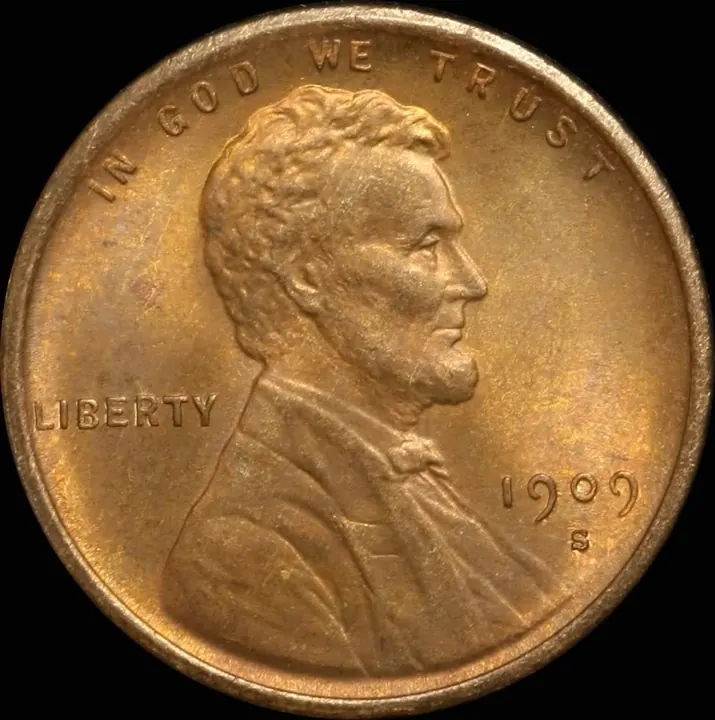
- 1909-S VDB. S mint mark under the date and the designer's initials VDB at the bottom of the reverse. Mintage 484,000. About $875 in Good (NGC Price Guide, November 2026).
- 1914-D. Mintage 1,193,000. About $185 in Good (NGC Price Guide, November 2026).
- 1922 no D. All 1922 cents came from Denver, but some dies were so worn the D did not show. The "strong reverse" variety lists at about $700 in Good (NGC Price Guide, November 2026). A weak or partly filled D is a different, much cheaper coin.
- 1931-S. Mintage 866,000. About $85 in Good (NGC Price Guide, November 2026).
Every one of these is faked, usually by adding an S or D to a common Philadelphia cent or by altering a date (a 1944-D tooled into a 1914-D, for example). Check that the mint mark matches the surrounding metal in color and wear.
1943 steel cents and the 1943 copper cent
In 1943 the Mint made cents from zinc-coated steel to save copper for the war. They are silver-gray and stick to a magnet. NGC lists a worn 1943 steel cent at $0.05 in Good, with bright uncirculated coins worth more (NGC Price Guide, November 2026).
A small number of 1943 cents were struck by mistake on bronze (copper) blanks. These are major rarities: NGC lists a 1943 bronze cent at $60,000 in Very Fine (NGC Price Guide, November 2026). Because of that, fakes are everywhere. Run the magnet test first: if it sticks, it is steel. Copper-plated steel cents and 1948 cents with the 8 altered to a 3 are the usual fakes. A genuine bronze 1943 weighs about 3.11 grams, while a steel cent is about 2.7 grams. Any candidate needs authentication by PCGS or NGC.
Take a picture and check its value with the estimator at the top of this page.
Doubled die cents: 1955 and 1972
A doubled die is an error in the die itself, so every coin it struck shows the same clear doubling in the lettering and date.
- 1955 doubled die obverse. Doubling in the date and in LIBERTY and IN GOD WE TRUST is easy to see without a magnifier. About $1,200 in Good (NGC Price Guide, November 2026).
- 1972 doubled die obverse. Strong doubling in the date and lettering. About $175 in Extremely Fine (NGC Price Guide, November 2026).
Most "doubled" cents found today show machine doubling, a flat shelf-like shadow caused by a loose die. It is common and adds little or nothing. Real doubled dies show rounded, separated second images.
1982: copper or zinc?
In 1982 the Mint switched from a 95% copper cent to a copper-plated zinc cent, and both kinds were made that year with large and small date styles. The easy test is weight: copper cents weigh about 3.1 grams and zinc cents about 2.5 grams. A scale that reads to 0.1 g is enough. Most 1982 cents of either metal are worth face value. The scarce one is a 1982-D small date struck in copper, which is a recognized transitional error.
Indian Head cents (1859-1909)
Before Lincoln, the cent showed Liberty in a feathered headdress. Common dates in low grades sell for a few dollars. The key date is the 1877, with a mintage of 852,500, listed at about $585 in Good (NGC Price Guide, November 2026). The 1909-S Indian cent is also scarce. On these coins the mint mark, when there is one, is on the reverse below the wreath.
How to read the date and mint mark
On Lincoln cents the date is on the front, to the right of Lincoln's bust, and the mint mark (D for Denver, S for San Francisco) sits directly below the date. No letter means Philadelphia. Use a loupe and light from the side.
Condition and color
Graders also note color: RD (red, full original copper color), RB (red-brown) and BN (brown). On key dates, red uncirculated coins can be worth many times brown ones. On a worn cent, look at Lincoln's cheek and jaw and the lines on the wheat stalks for wear. Never clean a penny. Rubbing, vinegar and polish leave scratches or an unnatural pink color that collectors avoid.
Photo tips for your penny
- Take one photo of each side, filling the frame.
- Light from a low angle at the side, not a direct flash, so the date, mint mark and any doubling show clearly.
- Add a close-up of the date and mint mark.
- Use a plain background and keep the coin as found, without cleaning.
- For a 1943 or 1982 cent, add a photo of the coin on a scale showing the weight.
When to get professional grading
Grading costs more than most cents are worth, so save it for coins that justify it: a key date you have checked carefully, a 1943 cent that does not stick to a magnet, a strong 1955 or 1972 doubled die, or a bright red uncirculated wheat cent of a better date. For rolls of common cents, sell in bulk instead. For other coins, see our coin value checker.
Questions people ask
Are pennies worth more now that the Mint stopped making them?
No, not for common dates. Billions remain in circulation and they are still legal tender, so an ordinary penny is worth one cent.
How much is a wheat penny worth?
Most common wheat cents in worn condition sell for a few cents each. Key dates such as the 1909-S VDB, 1914-D, 1922 no D and 1931-S are worth far more, as are uncirculated coins with original red color.
How can I tell if my 1943 penny is copper?
Hold a magnet to it. If it sticks, it is a common steel cent. If it does not, weigh it and have it authenticated, because nearly all copper-looking 1943 cents are plated or altered fakes.
Is my 1982 penny copper or zinc?
Weigh it. About 3.1 grams means copper, about 2.5 grams means zinc. Both are usually worth face value.
Can I melt pennies for the copper?
No. Federal rules prohibit melting or treating US one-cent coins, with narrow exceptions such as jewelry and novelty uses.