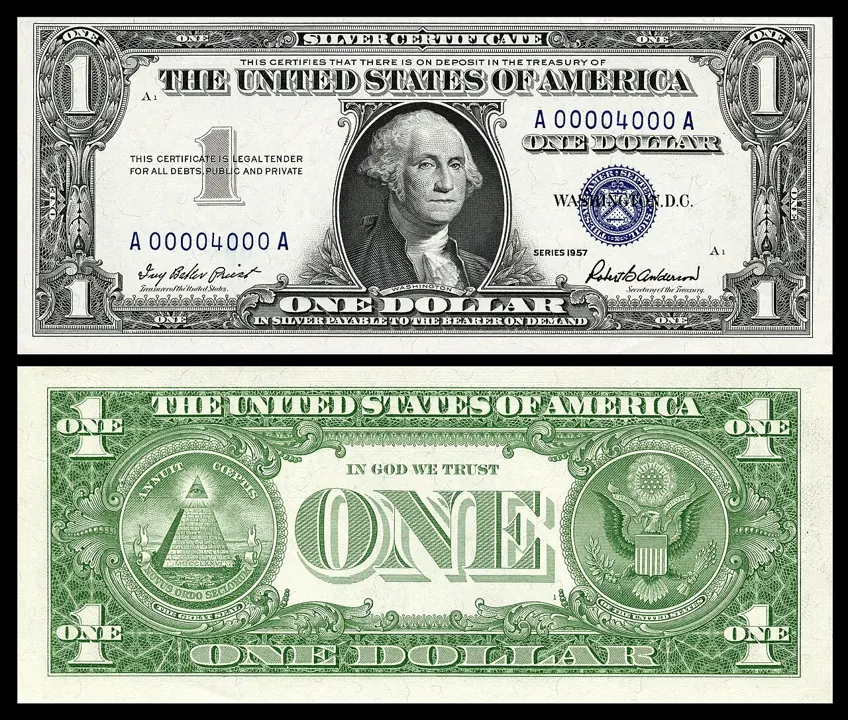
Dollar bill value comes down to four things: the type of note (shown by the seal color), the series date, the serial number and the condition. Most old money found in wallets, books and drawers is common and worth face value or a little more. The exceptions are large-size notes, early series, star notes, fancy serial numbers, real printing errors and bills that never circulated.
What drives old money value
- Type of note. Silver certificates, gold certificates, United States notes (red seals) and Federal Reserve notes were printed in very different numbers.
- Size and age. Large-size notes from before 1929 are far scarcer than the smaller notes used since.
- Condition. Folds, stains, tears and limp paper bring a note down fast. A crisp uncirculated note can be worth several times a worn one of the same series.
- Serial number. Star notes, very low numbers and patterns such as 11111111 can carry a premium.
- Errors. Genuine mistakes from the Bureau of Engraving and Printing are collected.
How to read the seal, series and serial number
Seal color tells you the type
- Blue seal: silver certificates. Small-size silver certificates carry series dates from 1928 to 1957. Redemption for silver ended on June 24, 1968, so today they are worth face value or a collector premium.
- Red seal: United States notes. Small-size red seals are mostly $2 and $5 notes from series 1928 to 1963, plus a few $1 and $100 issues.
- Gold seal: gold certificates. Small-size gold certificates carry the 1928 series. They are legal to own and cannot be redeemed for gold.
- Green seal: Federal Reserve notes. Almost all US paper money since the 1960s. The vast majority trade at face value.
- Brown seal: 1929 National Bank notes, which name a local bank, and World War II notes overprinted HAWAII. Yellow seal on a $1, $5 or $10 silver certificate marks World War II notes made for North Africa.
Series date and signatures
The series year is the year a design or signature combination was approved, not the year the note was printed. A letter after it (1957A, 1957B) marks a change such as a new signature pair, and that can split a common note from a scarce one.
Large-size versus small-size
Notes became about 30 percent smaller in 1929, shrinking to the 6.14 by 2.61 inch size still used today. The older large-size notes, which collectors call horse blankets, are noticeably bigger. Even worn, most genuine large-size notes sell above face value.
Star notes and how to look one up
A star in place of the last letter of the serial number marks a replacement note. When the Bureau of Engraving and Printing finds an imperfect sheet after numbering, it prints a star sheet with its own serial numbers instead of reusing the old ones (BEP serial numbers page, checked November 2026).
Star note value depends on how many were printed in that run. There is no official one-click lookup tool, but the BEP posts monthly production reports going back to 2002 that list each star note run by denomination, series, first and last serial number, and quantity. Find your series and denomination, then check whether your serial falls inside a run. Small runs are the ones collectors chase; most modern star notes come from large runs and are worth face value or a little more. The US Currency Education Program explains the other markings: on modern $5 and higher notes the first letter of the serial gives the series, and the second letter names the Federal Reserve Bank.
Fancy serial numbers
Collectors look for solids (all one digit), ladders (12345678), radars (12344321), repeaters (12341234) and very low numbers such as 00000001 to 00000100. Premiums are strongest on uncirculated notes.
Errors
Real errors include inverted backs, missing or shifted printing, mismatched serials, miscuts and fold-overs.
Take a picture and check its value with the estimator at the top of this page.
Condition and grading
Paper money is graded on a 1 to 70 scale. Low grades mean heavy wear and limp paper, middle grades mean several folds, About Uncirculated means a light fold or two, and Uncirculated (60 and up) means no folds at all. One center fold can drop a note out of the uncirculated range. Pinholes, tape, writing and repairs all lower value. Do not wash, iron or press bills; graders can tell, and a pressed note is valued below an honest one.
PMG and PCGS Banknote authenticate notes, grade them on that scale and seal them in holders. They also mark original, unpressed paper (EPQ at PMG, PPQ at PCGS) and record repairs.
Price guidance from published guides
These figures come from published price guides for typical notes in the grade named. Guide values are averages, not offers, and a dealer buying from you will pay less. Compare sold listings for your exact series, signatures and condition.
| Note | Guide value | Source |
|---|---|---|
| 1957 $1 silver certificate, worn but no tears or stains | About $1.50 to $2; rag-like or written-on notes about face value | PCGS article, checked November 2026 |
| 1957 $1 silver certificate, PCGS XF40 / Choice Unc 63 | $5 / $18 (star note $12 / $20) | PCGS article, checked November 2026 |
| 1928 $1 silver certificate, Fine 12 / XF 40 / AU 50 | $25 / $50 / $110 | PMG price guide, November 2026 |
| 1928E $1 silver certificate, Fine 12 / XF 40 / AU 50 | $350 / $800 / $1,400 | PMG price guide, November 2026 |
| 1928 to 1928F $5 red seal, Fine 12 | $10 to $30 depending on series letter | PMG price guide, November 2026 |
| 1953 $10 silver certificate, Fine 12 / XF 40 | $25 / $75 | PMG price guide, November 2026 |
Gold certificates and large-size notes generally sell well above face even when worn, but values swing widely by denomination, signatures and grade. PCGS puts the total at about 5.3 billion series 1957 $1 silver certificates were printed, which is why they stay inexpensive. For how photo estimates are built, see how we estimate.
Photo tips for paper money
- Lay the note flat and photograph the front and the back, filling most of the frame.
- Use even daylight with no flash, so the seal color reads true.
- Make sure the series date, the seal and both serial numbers are sharp and readable.
- Add one tilted shot to show folds, creases and any pinholes.
When to get a note graded
Grading makes sense for large-size notes, gold certificates, National Bank notes, early series, fancy serial numbers, apparent errors, scarce star runs and anything that looks uncirculated. It does not make sense for common circulated bills, where the fee is more than the premium. Old bills often turn up with old coins, so check those too with our coin value checker and silver dollar value checker.
Questions people ask
How much is my old dollar bill worth?
Most circulated $1 bills from the 1930s to the 1950s sell for a little over face. Early series, small star runs, fancy serials and uncirculated notes bring more.
Are silver certificates worth anything?
Common 1935 and 1957 $1 silver certificates in worn condition sell for a small premium over face. They can no longer be exchanged for silver.
Is a $2 bill worth more than $2?
Usually not. The $2 note is still printed, and worn green seal $2 bills, including the 1976 series, are worth face value. Red seal $2 notes, uncirculated notes and fancy serials can sell above face.
Is my star note rare?
Only if it comes from a small print run. Check your series and serial against the BEP monthly production reports; most modern star notes come from large runs.
Can I still spend old bills?
Yes. US paper money issued since 1861 remains legal tender at face value, including silver certificates and red seals. Check whether a collector would pay more first.